

A Quiet Conversation with Clay
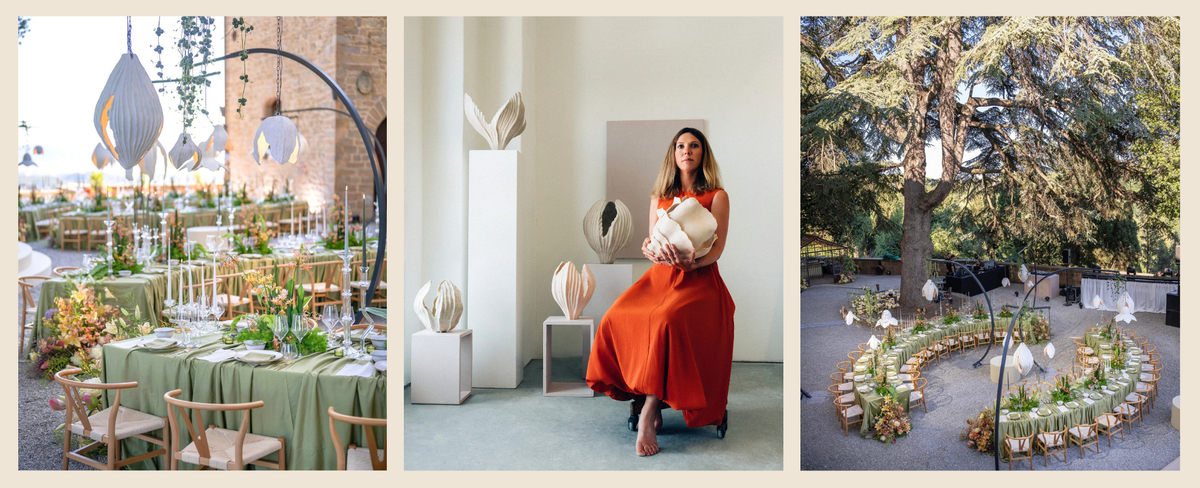
Marina Necker on memory, material, and the art of slowing down
My relationship with clay began, in a way, at home.
Since 2020, I have lived in a more than hundred-year-old house in Munich-Nymphenburg, which my husband and I renovated together. The process of shaping these rooms gradually led me away from painting and back to clay. At first, the impulse was simple and personal: I wanted to create my own lamps and vases for our home.
What began there became something much deeper. Working with clay changed not only what I was making, but also the rhythm of my days and the way I thought about time, memory and the traces we leave behind.
My work today moves between sculptural form and functional object. I am drawn to matte surfaces, fine lines and organic silhouettes, and perhaps most recognized for my Physalis Series, with its delicate, blossom-like forms.
But regardless of the piece, everything begins slowly.
Working Slowly
I build each vessel by hand, layer by layer, using coils of clay. It is one of the oldest gestures in ceramics, and I love the simplicity of it.
There is a quiet dialogue that happens between my hands and the material as I work. I can have an idea of what I want to make, but the clay always has a voice in the process. It sets boundaries. It opens possibilities. It asks me to be patient.
Clay forces me into calm. It urges me to pause, to stay present, and to feel each coil with my fingers. The material guides me: it shows me limits, opens possibilities, and teaches me patience.
The relief-like loops I build onto the surface and later remove leave behind fine lines that feel almost like traces. To me, they are marks of time, touch and concentration.
Then comes more waiting.
The pieces dry for weeks before undergoing two firings. Only then does this fragile material become stoneware. I find something beautiful in that transformation - strength emerging from something that began so delicate.
The Traces We Carry
I think of my vases as vessels for memory.
Relationships, experiences, emotions and moments from our past leave traces within us. I see a parallel in clay. When I work on a piece for hours and hours, the surface records that interaction. You can see how long and how intensely the hands have touched it.
The material remembers.
That idea fascinates me because I believe our memories do something similar. They become part of who we are, even when they are no longer immediately visible.
There is fragility in that, but also courage.
Finding Rhythm in the Studio
The physical work itself has a rhythm: kneading, forming, carving, smoothing.
These gestures are repeated again and again, and there is something grounding about that repetition. Working with clay requires my full attention. It pulls me away from everything happening outside the studio and back into the present moment.
My pieces often begin to feel like small protective spaces to me - places of gathering that connect interior and exterior.
I hope they invite the person living with them to experience some of that same stillness. To slow down. To look closely. To feel the material and notice the evidence of the hands that shaped it.
What Remains
Ultimately, my ceramics are as much about remembering as they are about form.
They are a conversation between myself and the material, but they are also part of a larger search for what remains: the experiences we carry with us, what we learn from the past and what we choose to preserve.
If my vases could speak, I imagine they might say: “Remember the past, preserve your memories, and use them to protect the present and the future. The mistakes of the past exist so we can learn. Nature gives us signs we should not ignore.”
Perhaps that is what I continue to search for each time I return to the studio - a way to give physical form to something that cannot always be held.
To memory. To time. To traces.
And to the quiet things that remain.
Upcoming Exhibitions
Nymphenburg Palace, Geranienhaus
October 2-6
Recent Collaboration
Marina recently created 20 handmade ceramic lampshades for florist Kiana Underwood, designed for her distinctive wedding projects.
Artist portraits photographed by Mona Shatry.

