

Wild Clay, Ancestral Forms, and the Nido Series by Maker Tere Pencel
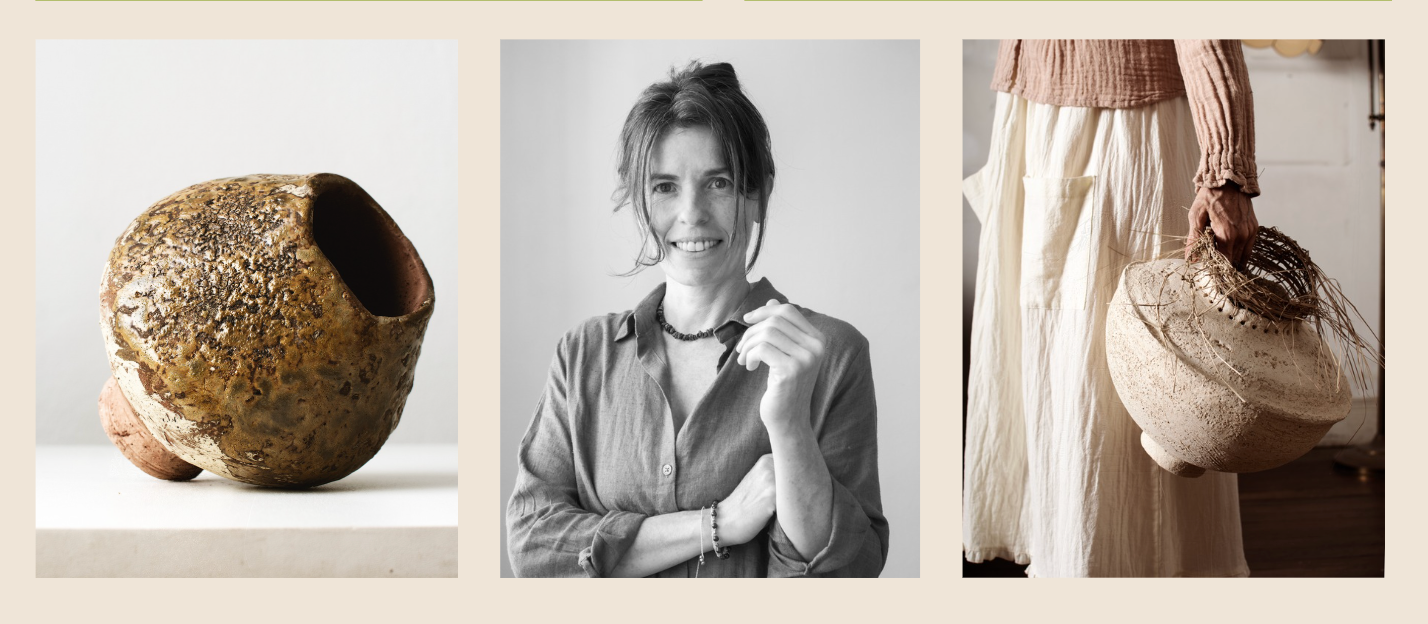
One of our 2026 initiatives is to give our makers the stage- sharing their work in their own words, with the voice, process, and meaning that live beneath the surface of every piece. There’s nothing more authentic than hearing directly from the creator about what they’re making and why.
For April, we’re honored to feature Tere Pencel, whose journal entry explores wild clay, ancestral influence, and the woven storytelling behind her Nido Series. We hope her words move you the way they moved us!
Wild Clay, Ancestral Forms, and the Nido Series
By: Tere Pencel
My work is deeply intertwined with the legacy of the pottery-making peoples who originally inhabited the territory of my country, Argentina. Those indigenous communities worked clay by hand, using the very same techniques I apply today. In many ways, my process is a personal reinterpretation of the vessels and pots that were once part of their daily life- objects I study with devotion.
I return again and again to Pre-Columbian art, revisiting books and ancient references to understand technique, proportion, and form. I feel particularly drawn to the San José Culture (900–1200 AD), located in Catamarca, Argentina, whose pottery- especially funerary urns- holds an imposing beauty. My work seeks to enter into dialogue with those forms, those volumes, and that palette of colors that defined an era.
At the center of everything is material. Red clay is my soil. Across much of Argentina, the earth carries a crimson hue- rich in iron oxide- which becomes powerful and present in the heat of the kiln. I choose to work with wild clay: a cluster of stones and earth that crumbles in my hands and constantly challenges me. In my early days, its resistance led me to frustration. Today, we have reached an agreement: in ceramics, you must let the clay teach you the way.
Sometimes I feel the clay is alive- Pacha Mama (Mother Earth) telling her story and allowing us to draw closer. This material has given me so much. Through it I have learned patience and strengthened my resilience, virtues that are indispensable for any ceramic artist. I have traversed the entire emotional spectrum: from tears of disappointment when a goal was not met, to tears of absolute joy when opening the kiln to find what I was looking for- or something even better.
My days begin early. After more than ten years in ceramic art, I have learned that organization and professionalization are foundations of growth. I start with physical training- mens sana in corpore sano- because ceramics demands strength and agility, especially when you prepare your clay by hand. Each 2.5 kg (5.5 lb) lump is kneaded at least a hundred times before it is used. When I arrive at the studio, mate is my constant companion as I dedicate the first hours to digital management and connecting with my community.
If someone had only 24 hours to understand the soul of my work, I would send them to the Museum of Natural Sciences in La Plata. For me, it is a sanctuary. Walking through anthropology and archaeology wings feels like traveling back in time; I study the volumes and ancestral techniques that I later strive to bring into the present.
Today my work focuses on developing ceramic bodies and artisanal glazes made from wild clays and wood ash. I harvest clay along the shores of the San Vicente Lagoon in the Province of Buenos Aires- a historic town founded over 240 years ago. My work begins at the water’s edge, observing soil parched by drought, cracked and dramatic. I remember my first trials with that harvested mud: it was as beautiful as it was frustrating. The material was indomitable, but I persisted. As Gustavo Cerati sings, “In the end, there is a reward.” The day my first piece survived drying and emerged from the kiln intact, I cried with joy.
Much of my energy is currently devoted to the Nido (Nest) Series. These are complex works built in parts, later joined using free-weaving basketry techniques inspired by traditional weaves of our ancestors. It is meticulous work that occupies hundreds of hours. I never seek one piece to be identical to another; each has its own identity.
My pieces manifest a drama between clay and nature. They are built in fragments, with openings that natural fibers attempt to unite through my intervention. The Nido Series explores duality: the interior as shelter and the exterior as challenge. The nest protects- it represents family, warmth, and the security that heals pain. Through this series, I hope the observer enters a state of meditation: on materiality, on the name, and on our connection to nature. Nature is one, and each of our personal nests is part of this suffering planet we inhabit.
I do not necessarily believe in “talent” as something innate. I believe in persistence toward that which inspires and moves us. Artistic expression is an intrinsic condition of being human; it is a healing tool that fulfills us spiritually and transports us to a moment of much-needed peace. My work is the result of that effort- and the constant search for healing through the clay.

