Pit Firing: Master Technique Explained
Of all ceramic firing methods, pit firing is the most elemental: earth, air, fire, and time sculpting color directly into clay. There are no kilns here—just a shallow pit, a patient hand, and an artist’s willingness to collaborate with flame. In this deep dive, we explore how pit firing works, why its surfaces look like captured weather, and how to collect pieces that carry the memory of fire into your home. Along the way, we spotlight exceptional works from Trove Gallery and the makers who keep this ancient practice vibrantly alive.
The roots and ritual of pit firing
Pit firing is as old as pottery itself. Long before kilns, early cultures from the Americas to the Mediterranean and East Asia hardened clay vessels in open flames and earthen pits. The method is deceptively simple: a vessel is tucked into a nest of combustibles—wood, straw, seaweed, sawdust—then burned slowly so heat and smoke can dance across the surface. What emerges is pottery with an atmospheric patina: smoky veils, charcoal blacks, rose blushes, and comet-like streaks that no glaze can replicate.
While contemporary ceramic artists now choose pit firing as an aesthetic decision rather than a necessity, the ritual endures. Every firing is a conversation with chance. The surface becomes a record of microclimates—where oxygen reached, where it didn’t, where salts flashed, and where a stray ember lingered. That living unpredictability is precisely what collectors cherish.
We honor that lineage in pieces across Trove Gallery. Some are true pit- or sawdust-fired works; others are kindred—wood-fired or flame-inspired—and chosen for how eloquently they speak the language of fire. Consider the sculptural Haniwa Warrior 93 by Noe Kuremoto ($1,700), whose archetypal presence nods to Japan’s earthen funerary figures; or the weathered skin of the Distressed Sardinia Vessel by Àlvar Martínez Mestres ($732), where patina reads like windborne ash. These objects don’t simply decorate a room; they change the room’s pace.
How pit firing works—From clay to ember
Even without a kiln, pit firing requires precise choices. Artists typically select a grogged earthenware or stoneware body that tolerates thermal shock. Surfaces are often burnished or treated with terra sigillata—a fine slip that, once polished, gives a velvet-lustrous sheen the fire can tint without the interruption of glaze. Some artists bisque-fire first to make the forms less fragile; others brave the full transformation from bone-dry to finished in the pit, which increases risk and reward.
The pit itself may be as humble as a garden trench lined with sand, or a dedicated barrel with venting holes. The loading is an art: pots are cradled in sawdust (for soft smoke and even heat), ringed with hardwoods (steady temperature), and interleaved with organic materials whose minerals color the clay. Dried seaweed can coax greens; banana peels and walnut husks encourage umbers; copper wire and steel wool (used thoughtfully and safely) can flash turquoise or gray. Each addition changes the atmosphere—more oxygen for brighter tones, more reduction for deeper blacks.
Firing begins with a slow preheat—small flame, plenty of patience—to drive off residual moisture. Then the pit is brought up to temperature with layered fuel. Rather than aiming for a specific pyrometric cone, pit firing watches the burn: the way embers leap, how smoke thins, and when the pit settles into a steady orange glow. Many firings last anywhere from three to ten hours. Cooling is equally crucial; burying the pit or sealing the barrel lets carbon and minerals imprint as the clay relaxes back to room temperature.
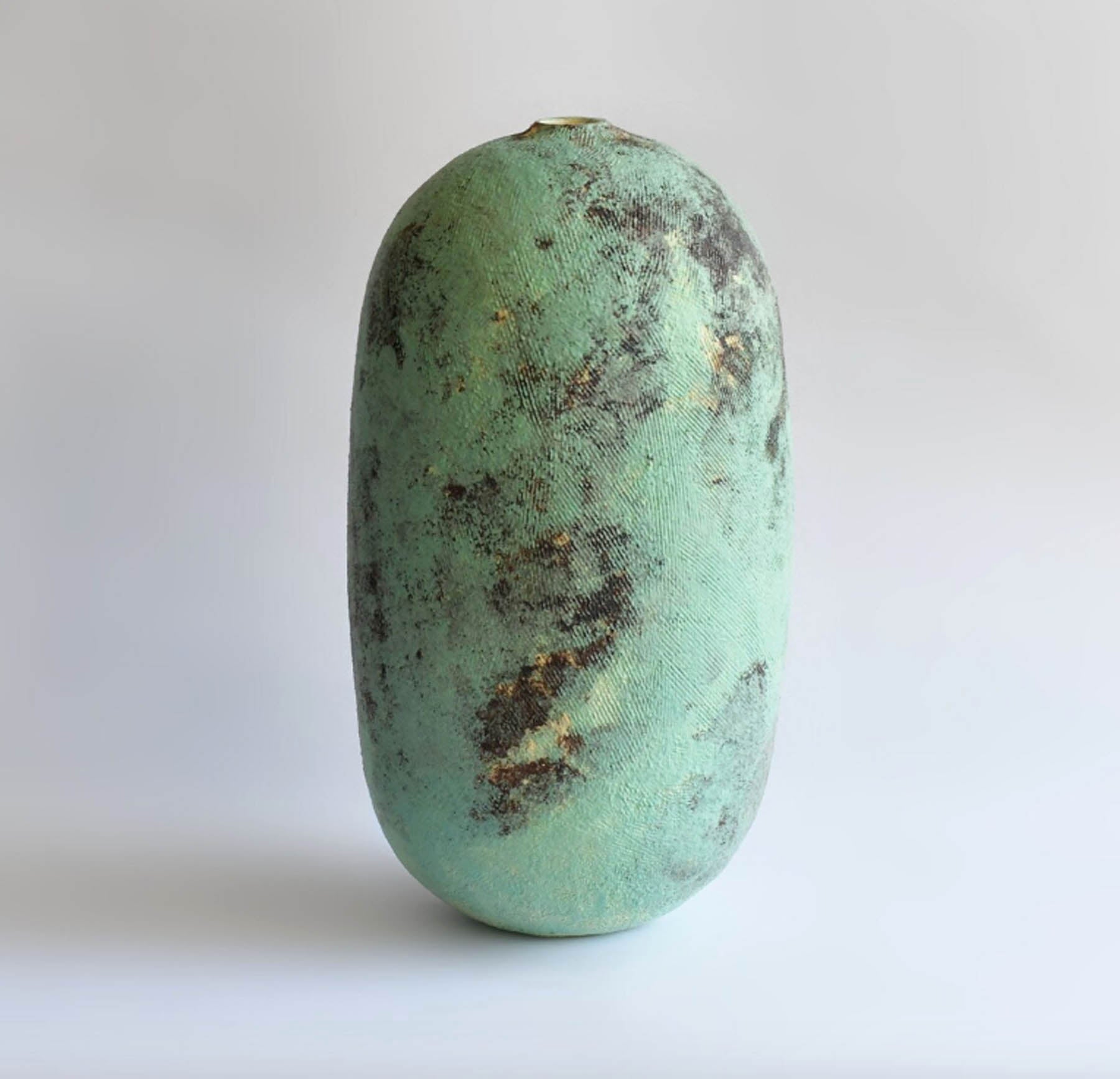
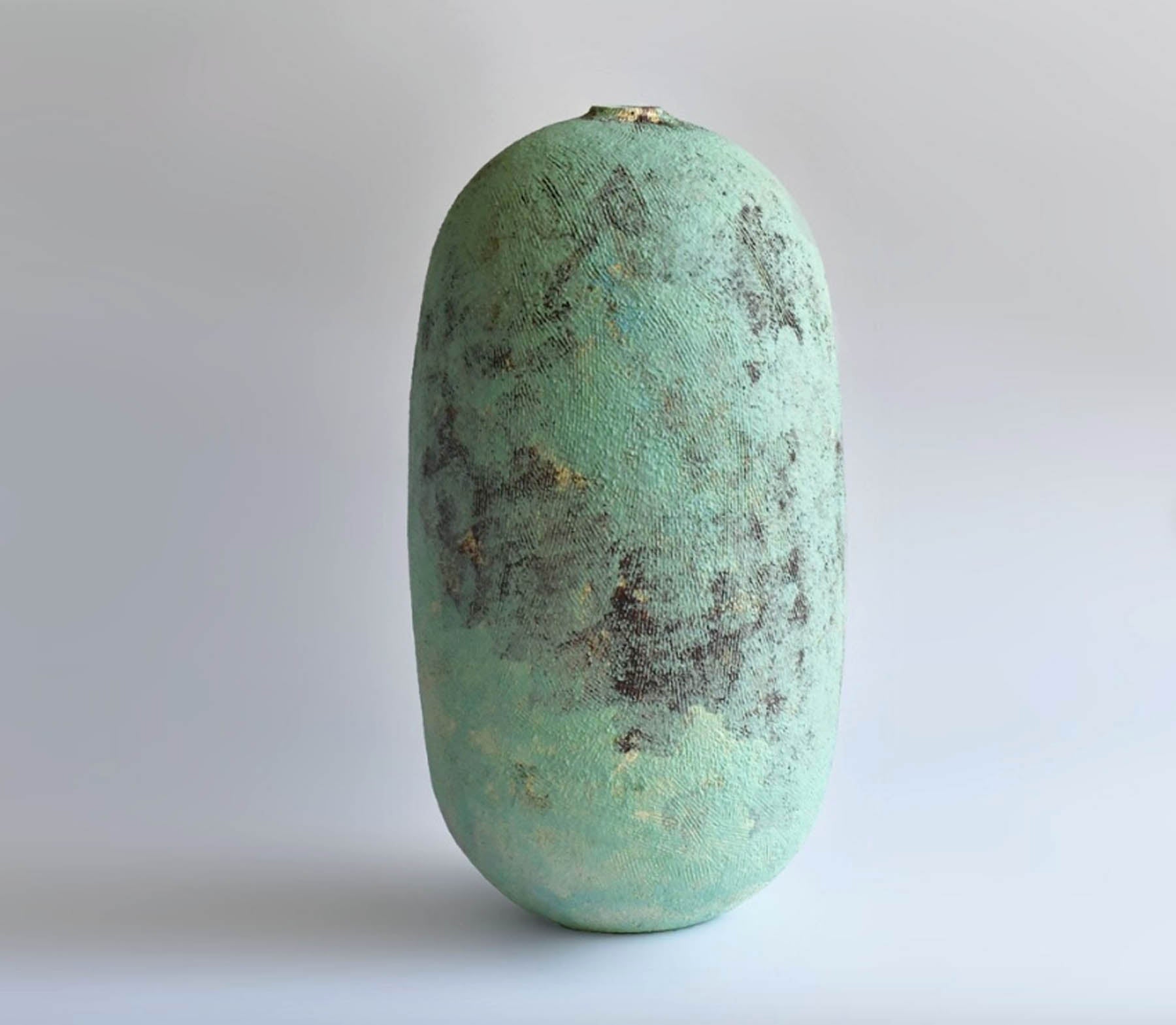
The results? A spectrum no glaze chart can predict. The silhouette of a leaf leaves a ghostly negative; a coil of copper whispers green; a plume of smoke leaves a stony gray gradient along a shoulder. It’s chemistry, yes—but it’s also choreography.
Among Trove’s works, the Sawdust-Fired Vase 49 by Michelle Grimm ($600) exemplifies the intimacy of smoke firing (a close cousin to pit firing) with feathered grays and deep char marks that feel painted by weather. For a related path through flame, Lilith Rockett’s Wood-Fired Porcelain Vessel 04 ($1,008) bears kiss marks of ash and ember, where a traditional kiln is replaced by wood’s drifting minerals. These vessels are quiet, but they hold a universe.
The palette of flame—Color chemistry decoded
Collectors often ask, “How do those colors happen?” Here is the short, beautiful answer: pit firing paints with atmosphere.
• Carbon black: When oxygen is scarce, smoke condenses on the clay, carbonizing into velvet blacks and graphite grays. Placing a vessel deep in sawdust or smothering it toward the end of the firing intensifies this effect.
• Blushes and toffee tones: As wood combusts, lignins and tannins volatilize, creating warm smoky browns. Organic materials and fruit peels introduce additional organics that blush peach to sienna, particularly on burnished terra sigillata.
• Mineral flashes: Copper sources can coax greens and aqua; steel can yield warm umbers to gunmetal. Naturally occurring salts in seaweed and coastal plant matter sometimes leave pale, toasted halos. The—often subtle—colors feel earned rather than applied.
• Iron and clay body: The clay itself matters. Iron-rich bodies warm toward brick and rose even in neutral atmospheres. White stonewares and porcelains reveal every wisp of smoke like breath on glass.
Because there’s no glaze layer, the best pit-fired surfaces are often those that have been burnished smooth. Light skims across them. The finish feels intimate—like driftwood you can’t help but touch. That tactile invitation is why pieces like Grimm’s sawdust-fired work and Rockett’s wood-fired porcelain read so human. Your eye follows the gradient; your hand follows the curve.
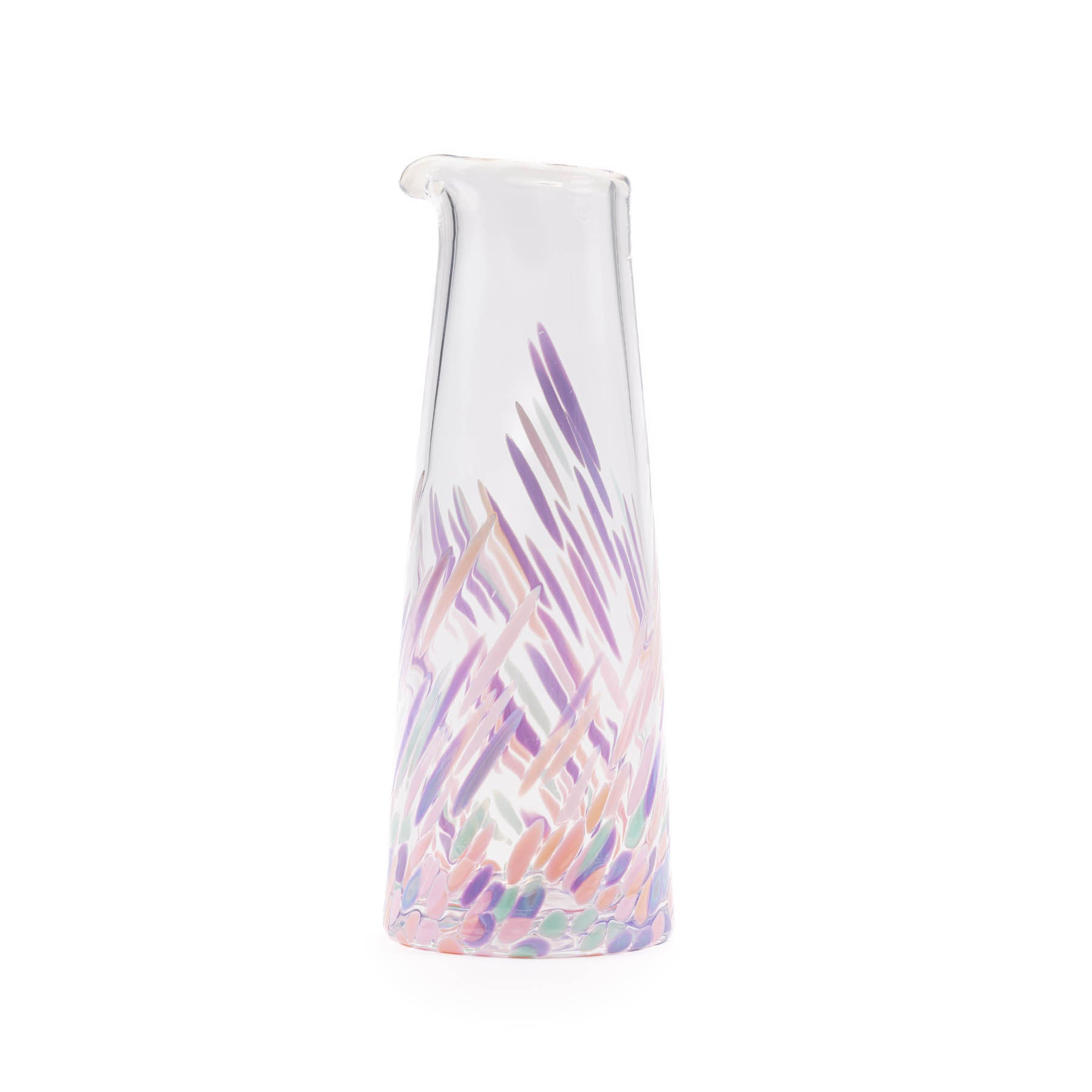
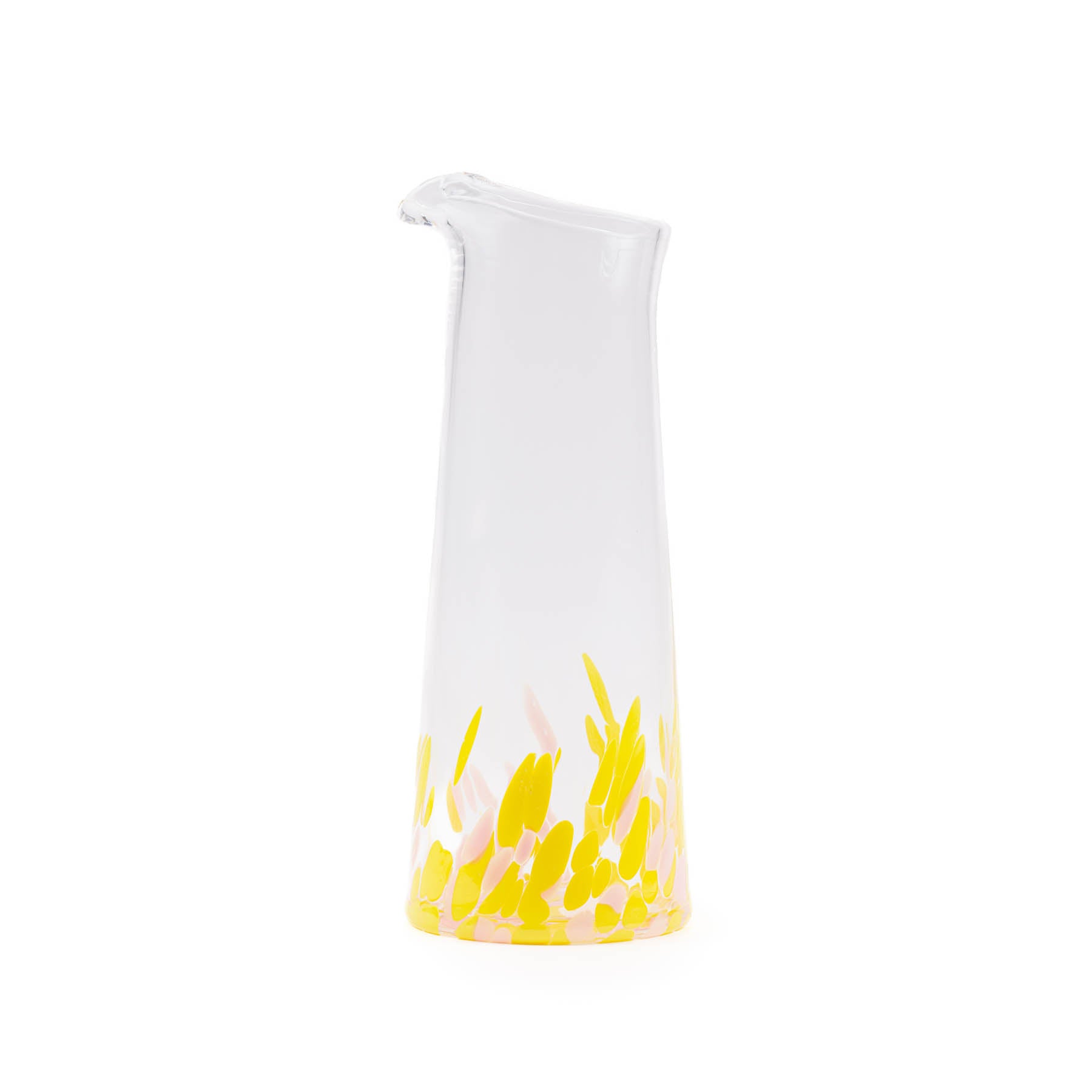
We love pairing these atmospheric ceramics with contrasting clarity in glass to heighten the dialogue. Consider the jubilant Confetti Carafe by Anna von Lipa ($214), studded with jubilant color that feels like a celebratory counterpoint to smoke’s moody palette. Or the crystalline Small Gema Vase by Moser ($1,179), whose gemstone-cut planes catch light with gemlike precision. Next to a pit-fired vessel, these pieces make each other brighter.
Forms that sing in the pit—Choosing and pairing for impact
Not every silhouette loves open flame equally. Pit firing rewards curves—the slow shoulders of a bottle, the swelling belly of a jar—with long, expressive gradients. Edges and tight recesses can accentuate contrasts, capturing darker smoke where air lingers. Thick walls help bridge thermal shock, while a continuous profile invites softer transitions of tone.
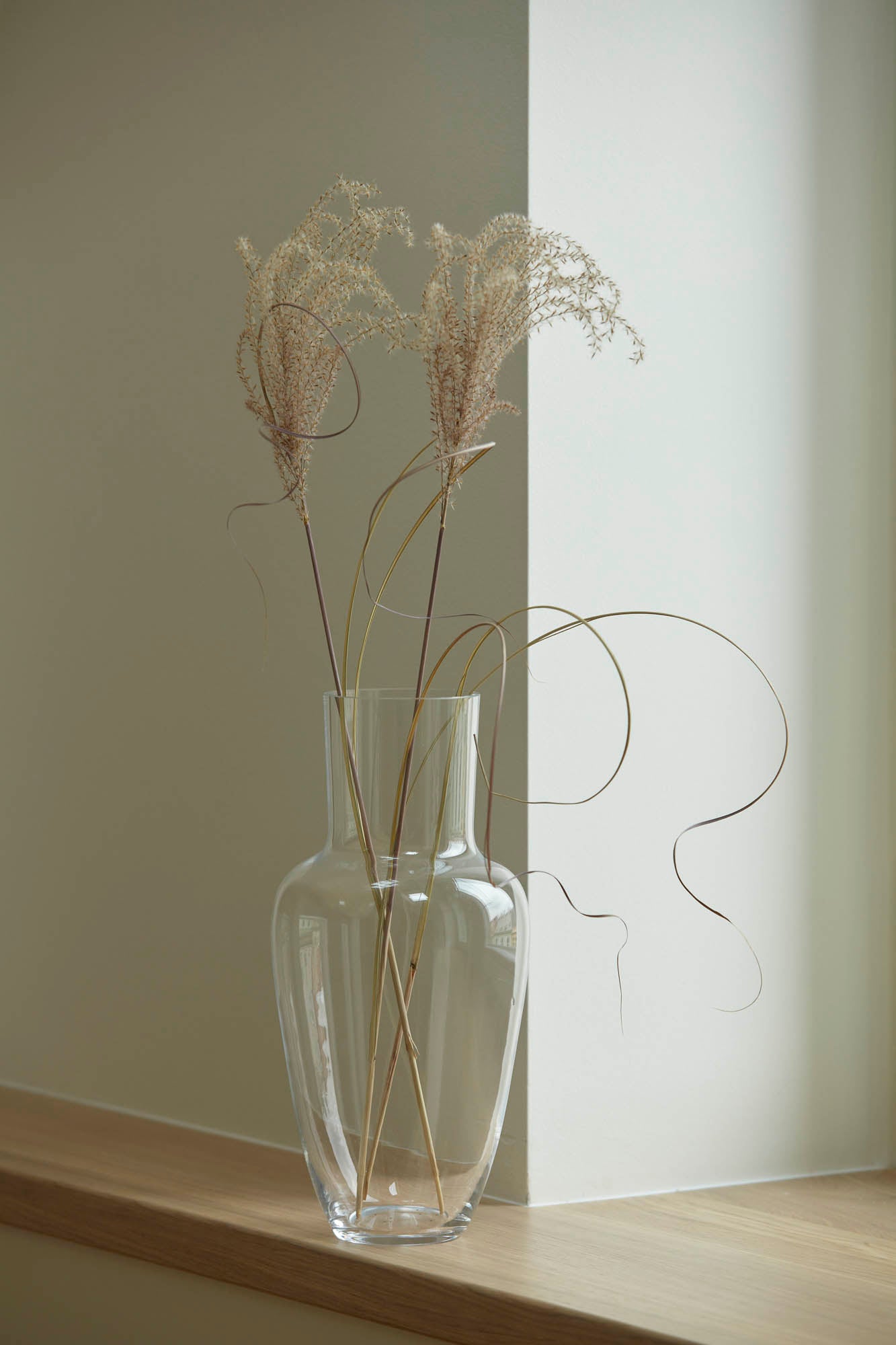
That’s why we often recommend sculptural forms with confident, readable massing. Noe Kuremoto’s Haniwa Warrior 93 ($1,700) channels the enduring geometry of ancient figures: straightforward planes, deliberate voids, a crisp silhouette that would hold its own beside any patinated vessel. On the opposite end of material language, František Jungvirt’s Transparent Garden Vessel ($825) is a meditation in glass—clear, refined, and ethereal—ideal for offsetting the earthbound tactility of pit-fired clay.
Texture and edge can be equally eloquent. Faustine Telleschi’s Ruffles Vase ($534) breathes in soft porcelain folds, throwing shadows that echo the ripples of smoke bands. Nadia Stieglitz’s Parure 8 ($2,800) reads like a composed necklace of forms—architectural yet sensual—its rhythms in step with fire’s slow tempo. Marcela Cure’s statement piece, Septem ($8,250), is a sculptural tour de force that anchors a room much as a large pit-fired work might: with gravity and grace.
For collectors drawn to the romance of patina, Àlvar Martínez Mestres’s Distressed Sardinia Vessel ($732) offers a timeworn skin that pairs beautifully with unglazed ceramics and ancient-inspired forms. Melina Xenaki’s Long Handle Bowl ($533) strikes a poetic balance between function and sculpture; those elongated handles cast elegant shadows—perfect beside a smoke-striped vase.
Accent pieces can extend the experience. The hand-cut clarity of Moser’s Small Gema Vase ($1,179) spotlights a single stem; set it against the mineral blush of a sawdust-fired piece and watch the conversation unfold. Nate Cotterman’s Tilt Bowl ($375), resting at a gentle angle, brings movement to a shelf the way flame brings movement to clay. For atmosphere, Dumae’s monumental Grande Jill Candle (scented or unscented) ($1,980) offers the literal glow of fire—soft, honeyed light that sympathizes with smoky surfaces. And for grounding warmth, Oscarmaschera’s leather Giovanni Basket ($362) adds a tactile counterpoint; the vegetable-tanned grain loves the company of clay.
Finally, a piece like Caroline Desile’s Clouds 01 ($778) frames the whole composition. Its atmospheric form—poised between sculpture and drawing—feels like a skyscape where smoke and light meet. Place it above a console styled with pit- and wood-fired ceramics, and the vignette breathes.
The makers behind the flame—Stories of material and hand
Great objects are always biographies. Here are a few of the makers whose pieces deepen our conversation with fire, smoke, and light.
Noe Kuremoto: Drawing on the timeless archetypes of Japanese haniwa, Kuremoto’s Haniwa Warrior 93 presents presence itself—an elegant reduction of gesture and gaze. Explore more from the artist in the Noe Kuremoto collection.
František Jungvirt: A master of contemporary glass, Jungvirt distills botanical clarity into pure form. The Transparent Garden Vessel suspends space within space. Discover the full breadth of his work in the Frantisek Jungvirt collection.
Anna von Lipa: Joy, confetti, and the sparkle of hand-blown glass define the studio’s signature language. The Confetti Carafe pours light as much as it pours water. Explore the Anna von Lipa collection.
Faustine Telleschi: Known for sculptural porcelain with fluent edges, Telleschi’s Ruffles Vase captures the gesture of soft material held at the edge of collapse. See more in the Faustine Telleschi collection.
Marcela Cure: Monumental and poised, Cure’s Septem anchors interiors with quiet drama. Each plane and seam is a study in balance. Visit the Marcela Cure collection.
Nadia Stieglitz: Sculptural rhythm, material restraint. Parure 8 reads like a conversation between links and light. Discover the Nadia Stieglitz collection.
Nate Cotterman: With the Tilt Bowl, Cotterman engineers play—an elegant lean that changes how we read a surface. Explore more in the Nate Cotterman collection.
Alongside these highlighted makers, we invite you to meet the quiet mastery of Lilith Rockett’s wood-fired porcelain, the elemental smoke surfaces of Michelle Grimm, the weathered poetics of Àlvar Martínez Mestres, the sculptural language of Caroline Desile, and the refined craft of houses like Moser and Oscarmaschera. Together, they form a chorus—each voice distinct, all tuned to the same key of material honesty.
Collecting, styling, and care—A curator’s guide
Choosing pit-fired and flame-forward pieces is as much about mood as it is about form. Start with a focal work whose surface reads at a distance: a sawdust-fired vase with a bold smoke band, or a large sculptural object like Septem that establishes scale. Build out with complementary voices: a burnished vessel like Sawdust-Fired Vase 49 for texture, a clear piece of glass like the Transparent Garden Vessel for brilliance, and a colored accent—say the Confetti Carafe—to catch the eye.
Balance is key. Pair a darker, carbon-rich piece with a paler form—Telleschi’s Ruffles Vase, for example—to modulate tone. Add a structural object, such as the Long Handle Bowl, to vary height and silhouette. For utility, a leather catchall like the Giovanni Basket introduces warmth and order to the ensemble.
Light completes the composition. Place a pit- or wood-fired piece where sidelight will graze the surface—on a console near a window, or under a picture light. For evenings, the Grande Jill Candle casts a mellow glow that feels profoundly sympathetic to smoky gradients. If your display sits beneath art, a sculptural work like Clouds 01 turns the wall into atmosphere.
Care tips: Because pit-fired and smoke-fired pieces are often unglazed and intentionally porous, treat them as you would a fine wooden object. Dust with a soft brush or microfiber cloth. Avoid soaking; if you use a vessel for flowers, slip a watertight liner inside. Keep away from sudden temperature swings and prolonged direct sunlight, which can lighten delicate smoke marks over many years. For wood-fired porcelains like Wood-Fired Porcelain Vessel 04, a gentle handwash is fine; avoid abrasives. For glass works—Transparent Garden Vessel, Tilt Bowl, and Confetti Carafe—handwash in warm water, dry with a lint-free cloth to maintain clarity. Leather pieces like the Giovanni Basket appreciate an occasional conditioning with a neutral leather balm.
Finally, trust your eye. Pit firing is a master class in embracing variation. Let each piece teach you what it wants to sit beside—and leave some air in your arrangement for the surface to breathe.
Bring the fire home
If pit firing is the oldest ceramic technique, its appeal remains thrillingly new: elemental, unrepeatable, and exquisitely human. Explore our flame-forward edit—true pit- and sawdust-fired ceramics, wood-fired kin, and luminous glass that frames their depth. Start with Michelle Grimm’s Sawdust-Fired Vase 49 ($600) or Lilith Rockett’s Wood-Fired Porcelain Vessel 04 ($1,008), then cast your eye across the spectrum—from the patinated Distressed Sardinia Vessel ($732) to the jubilant Confetti Carafe ($214) and crystalline Small Gema Vase ($1,179). Anchor the story with sculpture—Haniwa Warrior 93 ($1,700), Parure 8 ($2,800), or Septem ($8,250)—and finish with light from the Grande Jill Candle ($1,980).
Ready to curate your own atmosphere? Shop the full edit of flame-inspired works and meet the makers behind them. Explore collections by Frantisek Jungvirt, Anna von Lipa, Noe Kuremoto, Faustine Telleschi, Marcela Cure, Nadia Stieglitz, and Nate Cotterman. Then bring the fire home.