Sgraffito: Drawing in Clay
What Is Sgraffito? The Art of Drawing in Clay
Sgraffito is where sculpture meets illustration—where lines are not simply painted on but physically carved through layers of color to reveal the clay beneath. The term comes from the Italian sgraffiare, “to scratch,” and the technique has appeared across time and cultures, from Renaissance workshops to contemporary studios. In its most classic form, a potter applies slip or underglaze to leather-hard clay and then incises through that colored layer to create a crisp image or pattern. The resulting drawing isn’t just on the surface; it becomes the surface.
Collectors love sgraffito pottery for its tactile depth and graphic clarity. The contrast of light clay against a dark field—or vice versa—creates bold silhouettes that read beautifully from across a room, while the hand-carved lines reward close inspection. It’s a language of gesture: a way to sign a pot with movement, rhythm, and story.
At Trove Gallery, we’re fortunate to work with artists who give this technique fresh life, from vessels that echo classical forms to contemporary sculptures pulsing with modern pattern. Whether you’re a maker curious about process or a collector seeking your next heirloom, this deep dive will help you see—and feel—sgraffito in a new way.
Tools, Materials, and Timing: How Sgraffito Works
At the heart of successful sgraffito pottery is a precise choreography of material and moment. The clay must be leather-hard: not wet and floppy, not bone-dry and dusty, but in that sweet spot where the surface cuts cleanly and holds an edge. If the clay is too soft, lines blur; too hard, and the tool chatters or flakes the slip. Touch is the maker’s timer: the piece should feel cool and firm with a slight, velvety sheen.
Slip versus underglaze is a creative choice. Slip is a liquid clay colored with oxides or stains; it bonds intimately with the body and can give a buttery, matte base. Underglaze is a pigment-rich coating designed to stay put and keep its hue under clear glaze. Many artists mix approaches—laying down a toned slip, sketching in underglaze, then carving through both to build a three-dimensional drawing. After carving, most pieces are bisque-fired, then coated with a clear or translucent glaze and fired again to lock in the contrast.
Common tools include needle tools for hairline detail, loop and ribbon tools for wider grooves, and soft rubber ribs to gently clean away burrs without smearing the design. Even a sharpened wooden skewer can be a beautiful mark-maker. Some artists keep a damp sponge at the ready to wick away slip crumbs, preserving the clean edges that distinguish refined sgraffito work. And like any drawing, the hand position matters: brace your wrist on the pot if possible and carve in flowing arcs that follow the vessel’s curve to keep lines confident and continuous.
Because the process removes material, design isn’t only mark-making—it’s also restraint. Leaving areas uncarved creates essential breathing room so motifs can expand and contract across the form. In a well-considered piece, the composition wraps the pot like a score of music—crescendo, pause, reprise—so turning the vessel becomes part of the artwork’s narrative.
Carved Narratives: Featured Works at Trove
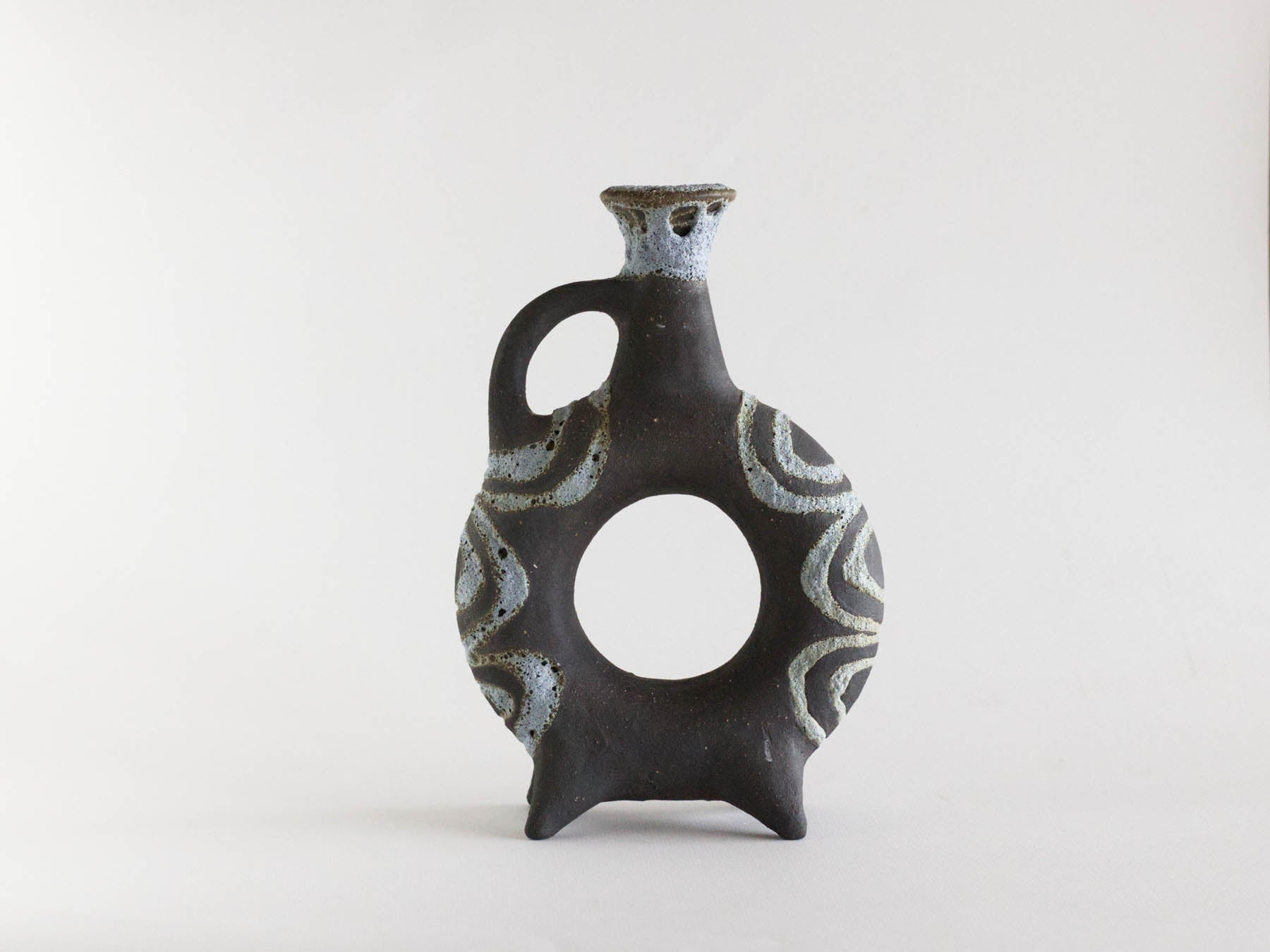
In our collection, you’ll find pieces that demonstrate the power of carved line and textured relief—works that feel both timeless and distinctly of now. Consider the classical silhouettes and rhythmic patterns of Melina Xenaki, whose vessels carry an echo of antiquity refined for contemporary interiors. Her Black Patterned Oenochoos ($467.00) plays with the traditional oenochoe pouring form, its dark field punctuated by patterned markings that read like a woven textile; the incised and painted geometry catches light as you move around it, revealing a dance of positive and negative space.
The Green Patterned Crater Vase by Xenaki ($566.00) amplifies these dynamics. The broad shoulders of the crater form give the carved pattern a generous stage, so lines can lengthen and shorten, compress and expand. Meanwhile, the Sun Philia Pot ($1,304.00) radiates warmth; the motif feels like a celebration of light itself, with rays and arcs that ooze joy. If your tastes skew to playful sophistication, the Pink Mermaid Jug ($1,598.00) brings curvilinear charm and a touch of myth—the type of piece that invites conversation without raising its voice.
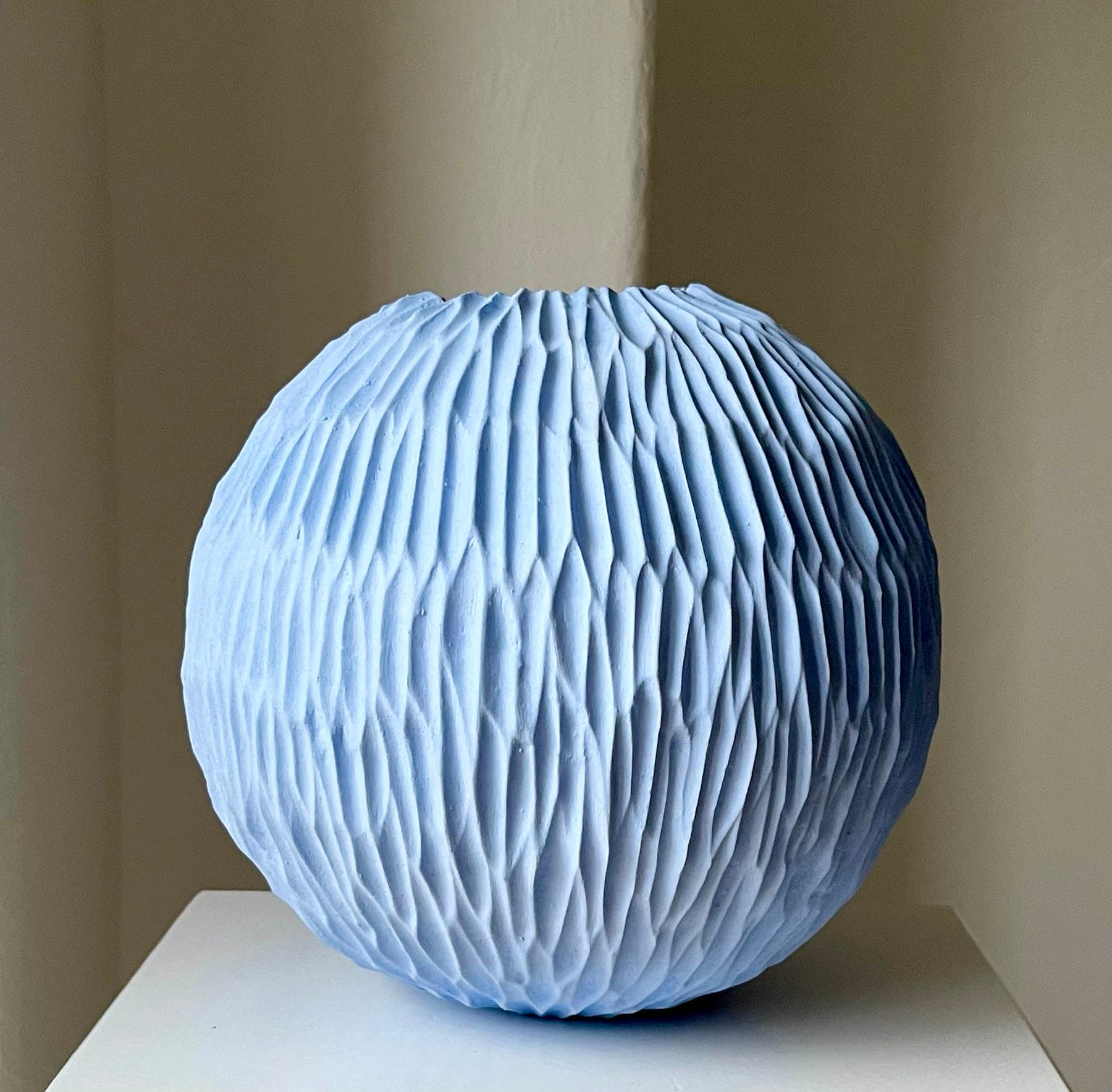
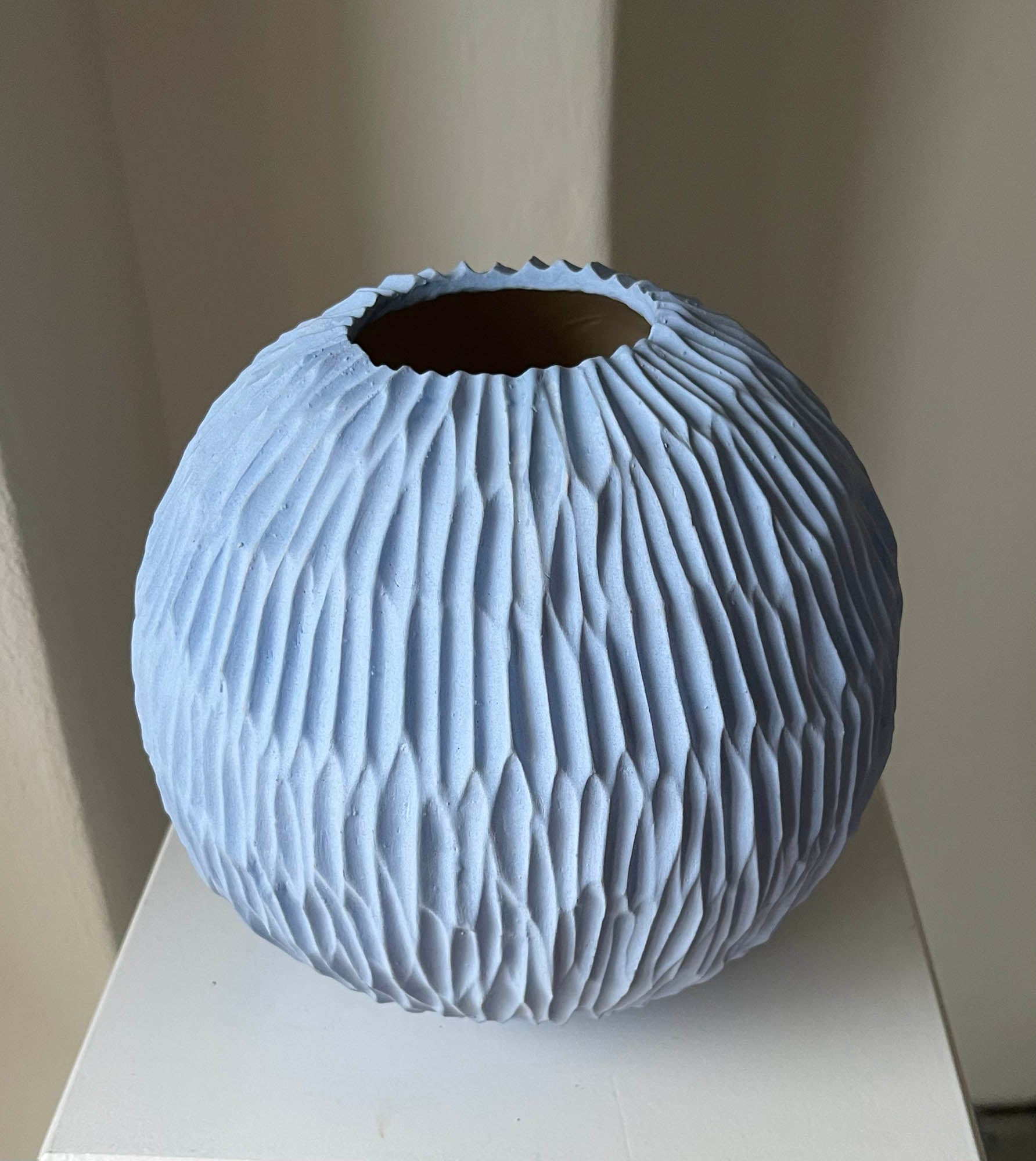
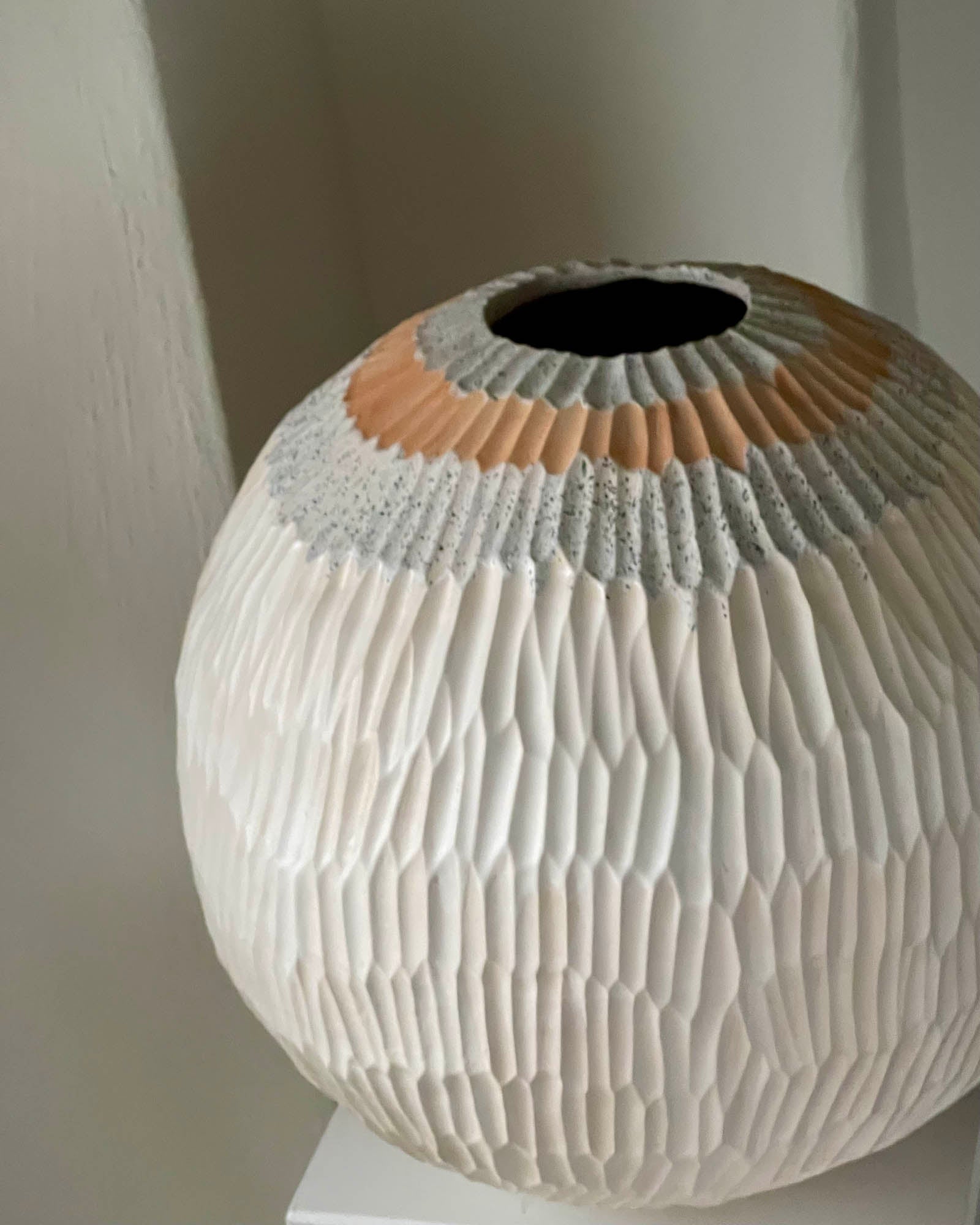
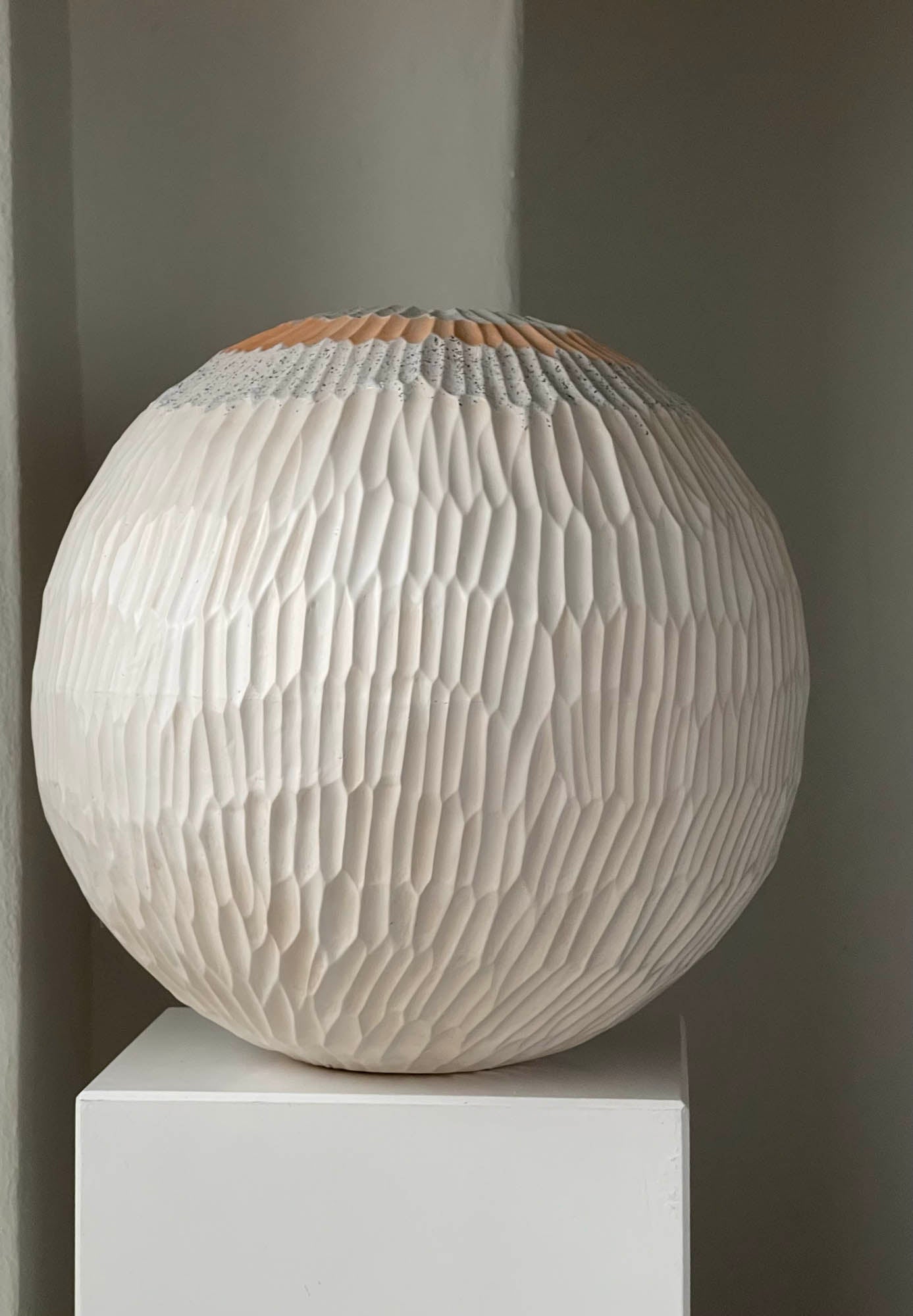
Organic line lives, too, in the work of Marina Necker. Her Large Root Vase ($267.00) and X-Large Root Vase ($826.00) offer sculptural silhouettes with surface movements that feel grown rather than drawn—like root systems mapping quietly beneath the earth. Their tactile skins hold shadows beautifully on a sideboard or pedestal, and their scale invites pairing: cluster the two sizes to create a living vignette of related forms.
When you want carving to feel as spontaneous as brushwork, look to Beverly Morrison. Her Gestural Earth Vessel 127 ($2,580.00) and Gestural Earth Vessel 126 ($3,000.00) are studies in movement: incised sweeps and nuanced textures read like a choreographed improvisation, translating the body’s arc into clay. These are works that reward slow looking—circling them is like reading a poem line by line.
Texture and relief can also take on a luminous quality. In the Waves Vase by GILLES CAFFIER ($1,684.80), striated surfaces catch light like ripples over sand, a rhythmic repetition that complements sgraffito’s emphasis on linear cadence. It’s a refined counterpoint to carved graphics—place it near a patterned vessel and watch the dialogue between gloss and shadow, wave and line.
The language of line extends beyond clay into architectural sculpture and stone. Delphine Cordie’s Utopia 30 ($6,453.00) carries a sculptural clarity—planes and edges articulating space with the same precision a potter uses to articulate a panel of sgraffito. And for a grounded, monolithic note, the Bobi Onyx Stool by Marbera ($5,502.00) is a piece of functional sculpture, its deep onyx veining creating naturally drawn lines within stone itself. Use it as a pedestal beside a carved vessel or as an anchor in a reading nook; the conversation between materials is immediate and elegant.
Finally, for collectors who appreciate the language of line distilled to its essence, Marcela Cure’s Septem ($8,250.00) reads like a meditation on rhythm and number. While not strictly sgraffito, its linear sensibility resonates with the technique’s spirit—proof that the pleasure of drawn line transcends medium. Together, these works sketch a spectrum: from crisp incisions and patterned bands to flowing reliefs and sculptural silhouettes, each piece offers a different way to experience drawing in three dimensions.
From Antiquity to Now: Motifs, Contrast, and Composition
Sgraffito’s graphic power comes from contrast, but the magic lies in how that contrast is composed around form. The curve of an oenochoe invites sinuous motifs that lengthen as they swing across the shoulder; a crater’s wide body is perfect for repeating bands and meanders; a jug with a narrow waist asks for motifs that cinch and release. This is why pieces like the Black Patterned Oenochoos and Green Patterned Crater Vase feel so right—their forms and patterns co-author the final look.
Historically, sgraffito pottery has channeled everything from botanical studies to heraldic devices. Contemporary makers continue that dialogue with motifs that echo the natural world—leaf veins, fish scales, waves, and sunbursts—translated into graphic shorthand. You can see these echoes in Xenaki’s references to classical vocabulary, in the root-like mappings of Large Root Vase and X-Large Root Vase, and in the gently undulating surface of Waves Vase. Each is a study in movement and repetition, expressed through cut, incised, or raised lines.
Color plays a pivotal role. A deep ground—charcoal, bottle green, or indigo—makes a pale clay body glow when revealed. Conversely, carving through a light slip into a darker body produces an inlaid feel. Many artists layer multiple tones, carving deeper in some areas to expose different colors like a topographical map. The final glaze can either set the design under glassy clarity or soften edges under a satin veil. There’s no single correct approach; the right choice is the one that amplifies the story the piece wants to tell.
For collectors, this means paying attention to edges and transitions. Are carved lines crisp? Do they widen and taper with intention? How does the motif resolve at the handle, foot, or rim? High-level sgraffito pieces behave like great drawings: they’re decisive, balanced, and alive across every inch of the page—or in this case, the pot.
Styling and Care: Bringing Sgraffito Home
Sgraffito ceramics are striking statement pieces, but they also play beautifully with texture-rich companions. Arrange a carved vessel with a minimal, monolithic form for balance—try pairing the gestural surfaces of Gestural Earth Vessel 127 or Gestural Earth Vessel 126 with the cool solidity of the Bobi Onyx Stool. Or create a rhythm of lines by grouping patterned works: the Black Patterned Oenochoos alongside the luminous Waves Vase forms a poetic counterpoint of matte and sheen, carve and relief.
Scale matters in display. Give the Sun Philia Pot or the Pink Mermaid Jug space to breathe on a console; let their motifs read in one glance, then invite guests to step close. The Green Patterned Crater Vase makes a compelling centerpiece on a dining table, where shifting daylight animates its carved pattern over the course of a meal. For a layered vignette, add the Large Root Vase and X-Large Root Vase at differing heights to create a sculptural “landscape” of interrelated forms.
Caring for sgraffito surfaces is straightforward. Dust with a soft, dry microfiber cloth or a soft brush to protect crisp edges. Avoid abrasive sponges or cleansers, which can dull glazed areas or catch on carved lines. If using a vessel for fresh flowers, consider a glass liner to protect delicate interiors and to make water changes easier. And as with all handcrafted decor, place felt pads under heavy sculptures to safeguard fine furniture.
For Makers and the Sgraffito-Curious: A Quick Guide
If you’re intrigued by the technique itself, here are simple principles makers rely on. First, plan your composition with a light underdrawing in pencil or a thin underglaze wash; keep your marks loose and rhythmic. Second, carve at leather-hard, testing the edge of a line on the base—shavings should peel cleanly. Third, carve with the form, not against it; let your hand follow the vessel’s axis, especially around curves. Fourth, clean as you go with a soft brush or damp sponge to keep edges crisp. Finally, test-fire small tiles with your chosen slip and glaze to preview color and contrast before committing to a large piece.
Curious about related techniques? Sgraffito often gets compared to mishima (inlaid slip), where lines are incised and then filled with contrasting slip before being scraped flush. Both emphasize line and contrast but create different surface feels: sgraffito lines are incised valleys; mishima lines are color-filled channels. Many contemporary artists hybridize the two for nuanced results.
Meet the Makers: Craftsmanship Across the Trove
Our featured artists approach line with distinct sensibilities. Explore the full range in each maker’s collection:
• Melina Xenaki — classical silhouettes, contemporary patterning, and a refined eye for proportion. Explore the Oenochoos, Crater, Sun Philia, and Mermaid Jug.
• Marina Necker — organic forms and root-like textures that bring nature’s diagrams indoors. See the Large Root Vase and X-Large Root Vase.
• Beverly Morrison — gestural vessels that translate movement into carved and textured surfaces: Vessel 127 and Vessel 126.
• GILLES CAFFIER — light-catching relief and refined texture in pieces like the Waves Vase.
• Delphine Cordie — architectural clarity and sculptural balance exemplified by Utopia 30.
• Marbera — stone artistry that complements carved ceramic lines, including the Bobi Onyx Stool.
• Marcela Cure — elegant, line-forward work such as Septem that resonates with sgraffito’s drawn spirit.
Across these collections, you’ll find a shared devotion to craftsmanship: careful timing, crisp edges, and the sensitivity to let a line be simple when simple is most powerful. That’s the enduring appeal of sgraffito—it celebrates both the discipline of technique and the immediacy of the hand.
Collect with Confidence: What to Look For
When evaluating sgraffito pottery, consider three qualities. First, precision: look for lines that are clean and intentional, without ragged burrs or unplanned chatter. Second, composition: turn the piece slowly—does the motif resolve gracefully around handles, spouts, and rims? Third, surface unity: after glazing, do carved areas and untouched areas feel coherent, with contrast that enhances rather than overwhelms?
Pieces like the Black Patterned Oenochoos ($467.00) and Green Patterned Crater Vase ($566.00) demonstrate all three: crisp edges, balanced patterning, and a harmony between form and decoration. Sculptural companions—the Waves Vase ($1,684.80), Utopia 30 ($6,453.00), and Bobi Onyx Stool ($5,502.00)—extend that conversation with texture and silhouette, so your space becomes a gallery of lines in dialogue.
Ready to curate a personal narrative? Start with one statement piece—perhaps the luminous Sun Philia Pot ($1,304.00) or the expressive Gestural Earth Vessel 126 ($3,000.00)—and then add complementary works that echo or answer its lines. Over time, you’ll build a collection that feels not merely assembled but composed.
Call to action: Explore the full selection of carved and textured works now. Shop featured pieces directly through the links above, and discover more in each maker’s collection at Trove Gallery. When you’re ready, our curatorial team is here to help you find the next piece that completes your story.